

Question

Shopify created Abandoned checkouts case, but Klaviyo did not send emails

  • December 1, 2025
  • 6 replies
  • 52 views

Forum|alt.badge.img

Hello,

We’ve set up an Abandoned Cart Reminder (Email) auto-flow in Klaviyo, using the trigger “When someone checkout started” to send reminder emails to customers who have abandoned their carts.

During our testing, we noticed an unexpected behavior:

When the same customer starts multiple checkout sessions using different browsers or devices (e.g., PC and mobile), Shopify creates multiple abandoned checkout cases.
However, Klaviyo only sends one abandoned cart email instead of one for each abandoned checkout session.

Could you help us understand:

  1. Why Klaviyo does not send multiple emails in this scenario?

  2. Which flow setting, event property, or built-in suppression rule is preventing the second email from sending?

  3. Is this behavior expected, or should we adjust any filters, triggers, or flow configurations to ensure correct handling?

Any clarification or recommendations would be greatly appreciated.
Thank you!

Best regards

6 replies

whereisjad
Expert Problem Solver IV
Forum|alt.badge.img+16
  • Expert Problem Solver IV
  • December 1, 2025

@teachateau the ultimate answer to your predicament might be in this article here 


cadence
Expert Problem Solver II
Forum|alt.badge.img+8
  • Expert Problem Solver II
  • December 1, 2025

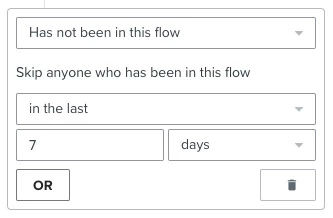
@teachateau, this is either due to (1) smart sending, which is enabled by default on your flow messages, or (2) a profile filter on the flow that looks something like this which is checked before each action in the flow is executed.


You could theoretically turn off smart sending for the flow message OR adjust such a profile filter. I do think it’s worth having some kind of filter. Typically subscribers don’t like getting multiple duplicate abandon cart emails in the same day, even if they’re shopping across multiple devices. 

Klaviyo has a good guide on setting up an abandoned cart flow here - https://help.klaviyo.com/hc/en-us/articles/115002779411


Cadence / Book a demo


Forum|alt.badge.img
  • Author
  • Contributor I
  • December 4, 2025

Hello,

Thank you for your previous response. I understand now that the first issue was caused by Smart Sending, which prevents customers from receiving multiple emails within the defined timeframe.

However, we conducted a new test after reducing the Smart Sending window to 1 hour, and we are still experiencing unexpected behavior:

  • The same customer waited over 3 hours

  • Then used a different browser (with confirmed different cookies / no shared session)

  • Started a new checkout, and Shopify correctly created a new abandoned checkout record

  • But Klaviyo did not send a second Abandoned Cart Reminder email, even though:

    • Smart Sending window had already passed

    • The new checkout should be treated as a separate event

    • The customer should re-enter the flow


Could you please help us verify:

  1. Whether our current flow configuration is correct

  2. What specific rule, filter, or suppression logic could be preventing the second abandoned cart email from sending

  3. Whether Klaviyo treats multiple checkout_started events from the same customer differently under certain conditions

  4. If there is any event-level information we should check (e.g., duplication handling, timestamp logic, profile-level suppression)

We would appreciate it if you could review our setup and help us identify the exact cause of this behavior.

Thank you again for your assistance.

Best regards


cadence
Expert Problem Solver II
Forum|alt.badge.img+8
  • Expert Problem Solver II
  • December 4, 2025

@teachateau I mentioned it was either a smart sending issue or a flow profile filter issue. Looks like it was both! 
 

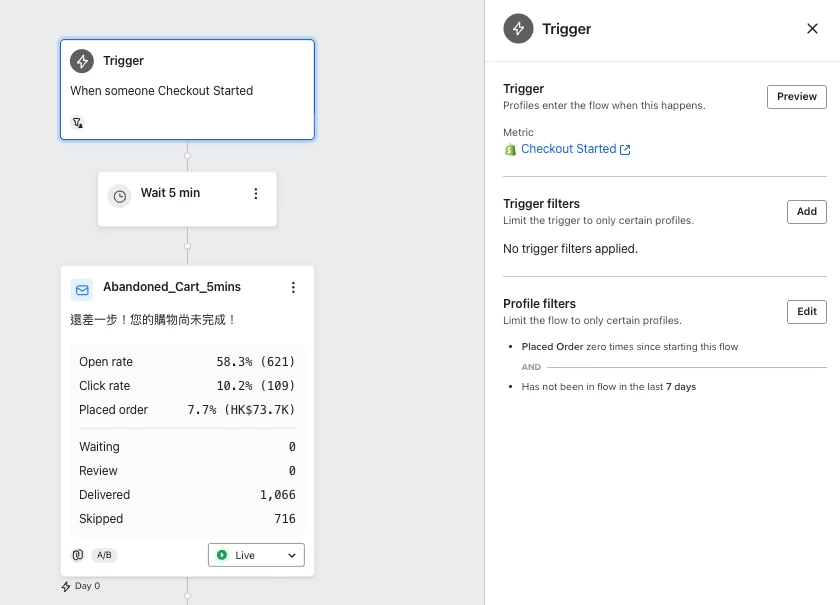
Under profile filters in the right side of your screenshot, it says “Has not been in flow in 7 days”. This would cause anyone who has been in this flow in the last 7 days to be *excluded* from re-entering and having an email sent.


As I mentioned, you might not actually want to send a profile two abandon cart emails in such a short timeframe, but that’s your choice! 


I hope this helps! 

Cadence / Book a demo


Forum|alt.badge.img
  • Author
  • Contributor I
  • December 7, 2025

Hello,

We are seeing a discrepancy between the number of customers who triggered “when someone checkout started” in Klaviyo and the number of abandoned checkout records shown in Shopify.

Based on the two screenshots:

  • On 5 Dec, Klaviyo recorded 3 customers who triggered the checkout started event and all 3 received the first abandoned cart email after the 5-minute delay.


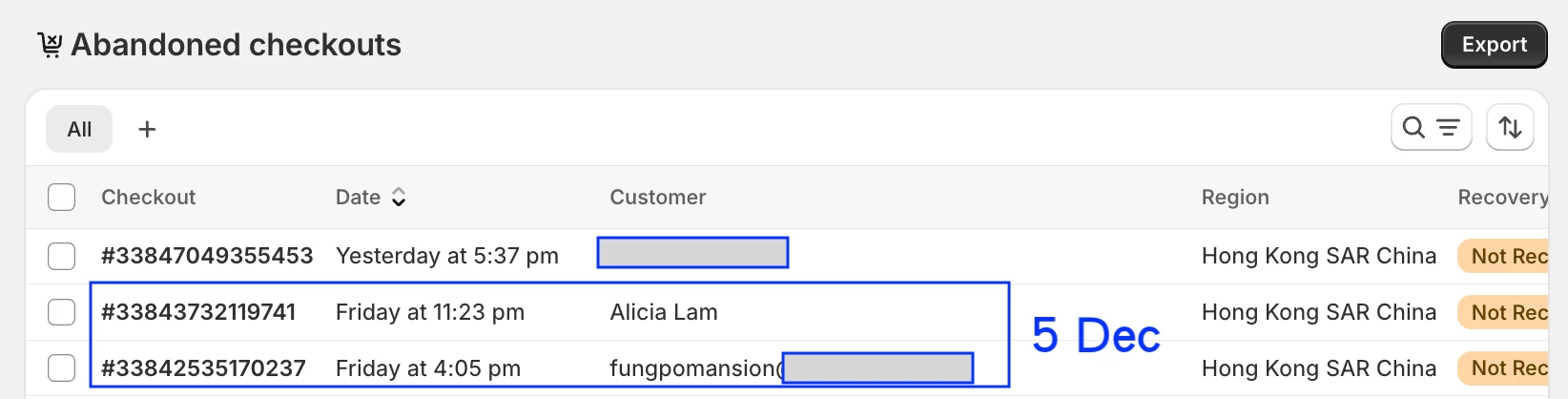
  • However, in Shopify, the abandoned checkout record for 5 Dec shows only 2 customers, and neither of these two appear in Klaviyo’s email send log.


We would like to understand:

  1. What are the exact differences between Klaviyo’s checkout started trigger logic and Shopify’s abandoned checkout record logic?

  2. Why would Klaviyo detect 3 checkout starts and send abandoned cart emails, while Shopify only records 2 abandoned checkouts—and the customers from Shopify’s records do not appear in Klaviyo’s triggered email list?

Any clarification on how both systems define and track checkout events would be greatly appreciated, as this mismatch is impacting our analysis and automation setup.

Thank you!

Best regards,


  • Contributor I
  • December 8, 2025

Great question! You’ve hit on a key difference between how Shopify and Klaviyo operate.

Klaviyo’s checkout-related events ultimately originate from Shopify checkout activity, and one important thing Klaviyo does is attempt to reconcile events that don’t yet contain PII (email or phone) with previously known visitors. This reconciliation is done using first-party cookies and historical profile context.

Technically, a Shopify checkout-started signal fires as soon as a shopper loads the checkout page — before any contact info is collected. Additional Shopify checkout events fire as the checkout is updated to capture more data.

If Klaviyo has cookie context, it can associate that early checkout activity to an existing Klaviyo profile before the shopper explicitly identifies themselves. If there is no cookie context, Klaviyo typically has to wait until the shopper enters email or phone during checkout before attaching the Checkout Started event to a profile (or creating a new one).


Why Klaviyo and Shopify Numbers Don’t Match


Klaviyo’s Checkout Started trigger is event-based and can fire as soon as a shopper enters checkout — even before they provide contact information. Shopify’s Abandoned Checkout report only includes checkout records that were fully created and persisted (typically requiring email or phone).

Because of this, the two systems are not expected to match 1-to-1.

A. Identity mismatch

Shopify abandoned checkouts may:

  • Contain an email that is not yet associated with a Klaviyo profile

  • Belong to a customer who has opted out or is otherwise suppressed

  • Be excluded due to global suppression, smart sending, or flow filters in Klaviyo

As a result, Klaviyo will not retroactively attribute those Shopify checkout records to the same identities that triggered earlier checkout events.

B. Different timing windows

  • Klaviyo flows are often triggered earlier (near-immediate checkout activity)

  • Shopify abandoned checkouts are recorded later, after checkout persistence rules are met

  • By the time Shopify marks a checkout as “abandoned”:

    • Klaviyo may have already sent the email

    • Or skipped sending due to prior email sends, suppression, or order completion

How to investigate further

To reconcile specific cases, it’s helpful to:

  • Check whether the Shopify checkout email exists as a profile in Klaviyo

  • Review the Klaviyo profile activity log for checkout and email events

  • Confirm the profile’s suppression status (global or flow-level)

  • Verify whether smart sending or other flow filters applied at send time


For context: I work on Kluvos, where we focus on capturing and reconciling early-funnel ecommerce events. Many Klaviyo vs Shopify discrepancies that surface at checkout actually originate earlier in the funnel, where identity and session context are more fragile. By retaining that context more reliably across product views and add-to-carts, these gaps become much easier to understand — and downstream flows tend to perform more consistently.