




How I built a connected marketing ecosystem with Klaviyo data at the center

Why Klaviyo works well as a CDP and the top 5 tools that extend it across marketing channels.
Most direct-to-consumer marketers think of their email platform as exactly that: an email platform.
When I started in email marketing back in 2013, the system you used to send emails was simply called an ESP — an email service provider. The focus was on that single channel.
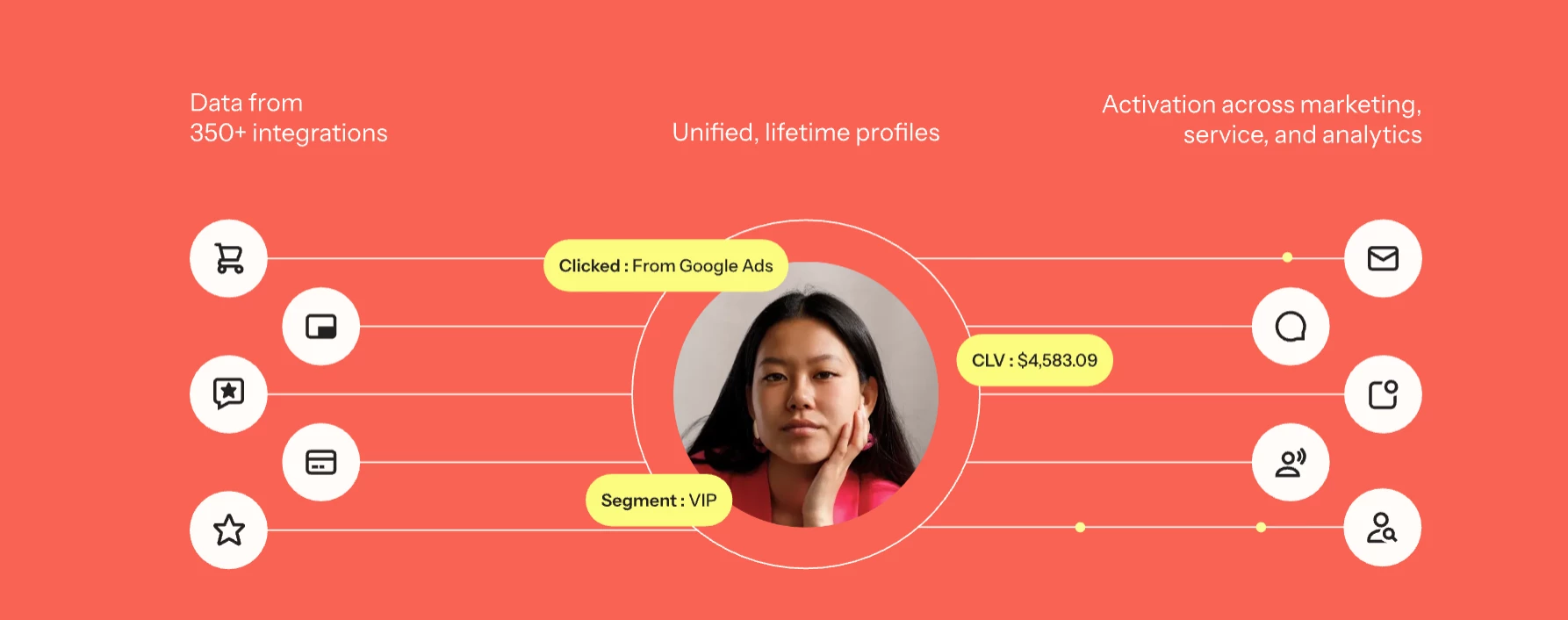
But the way we think about these platforms has changed. Klaviyo still functions as an ESP, but it’s evolved into something much broader. It includes channels like SMS, WhatsApp, and push notifications directly in the platform, and it also acts as a Customer Data Platform (CDP). That means all of our customer data lives in one place and can power messaging across multiple channels.
I'm the retention marketer at Criquet Shirts, an Austin-based menswear brand. I run our retention marketing as a one-person team, which means I need every tool in our stack to work harder and smarter. Over the past several years, I've built an ecosystem of integrations around Klaviyo that extends our reach far beyond the inbox.
Here's how each piece works together, and the specific results we're seeing.
Starting with Klaviyo’s built-in intelligence
Before I describe the external tools in our stack, it's worth noting what Klaviyo does natively. The platform's predictive analytics forecast when customers are likely to buy next, identify churn risk, and estimate lifetime value. That intelligence powers our segmentation and timing decisions. For smaller teams, Klaviyo's AI can also generate campaign content, optimize send times, and even plan your marketing calendar.
I use these native capabilities as my foundation. The third-party tools I'll describe next extend Klaviyo's reach to channels the platform doesn't natively support, including direct mail, connected TV (CTV), and specialized machine learning models. But it works because everything connects back to Klaviyo's unified customer profiles.
Machine learning segmentation with Orita
The first goal of any campaign is showing it to the right people. I create segments in Klaviyo based on engagement and purchase behavior, but I'm working with limited brain capacity, I can only hold so many signals in my head when building segment logic.
The average brand has over 250 million Klaviyo events, according to Orita's co-founder Daniel Brady. That's every email open, every click, every page view, every cart action, every purchase, multiplied across your entire customer base. No human can process that volume of data to identify who's most likely to engage with tomorrow's campaign.
That's where machine learning segmentation comes in. We use Orita to process all of those signals and update propensity-to-engage predictions daily. The practical impact: Orita identifies customers I would have manually suppressed who are actually showing buying signals. Last year, they found over $34 million in revenue from profiles sitting in brands' suppression lists. As a one-person marketing team, I could never catch those signals at scale.
Once we've identified the right people to message, the next challenge is what happens when they actually click through.
Extending personalization from inbox to website
Once someone clicks through from an email, we want the on-site experience to continue the conversation. If I email a customer about our new linen polos, they shouldn't land on a homepage showing winter flannels.
Digioh lets us create personalized on-site experiences powered by Klaviyo segments. Our sign-up unit shows different offers based on traffic source. Our promo banner changes based on customer lifecycle stage. Our in-cart messaging adapts to purchase history.
The biggest win has been our on-site quiz. Digioh captures quiz answers, style preferences, size, occasion, and sends that data back to enrich Klaviyo profiles. Our quiz follow-up flow outperforms our other flows on every efficiency metric. That's because we're not guessing what they want, they've already told us.
As Blake Imperl, SVP of Marketing at Digioh, puts it: by recognizing more shoppers and triggering more lifecycle flows, brands grow their lists faster, personalize smarter, and drive significantly more flow revenue.
But what about customers who don't engage with email at all?
Reaching customers who don't respond to email
The biggest insight from using Orita: a significant portion of our customers simply don't respond to email. They're not bad customers, email just isn't their channel.
Direct mail is how we reach them. We recently sent postcards to unsubscribed customers announcing a sale. We also built a Klaviyo flow that triggers a personalized PostPilot postcard based on a customer's Digioh quiz results, so someone who told us they prefer classic styles gets different creative than someone who wants bold patterns.
Both campaigns target Klaviyo segments, which means we're only spending postage on customers with specific characteristics. The result: 15x+ ROAS on our PostPilot postcards. For context, direct mail costs more per impression than digital channels, but when you're reaching the right people with the right message, the economics work.
As PostPilot notes, combining email and direct mail, and tying in tools like Orita and Digioh, means you can maximize touchpoints with customers and reach the right person with the right message on the right channel at the right time.
For more use case insights on incorporating direct mail into your omnichannel strategy, this post recaps strategy from Brina Skof, CRM and Loyalty Lead at Loop Earplugs.
Direct mail reaches people in their homes. But there's an even bigger screen available.
Taking your marketing to the big screen
Connected TV, streaming ads on platforms like Hulu, Roku, and YouTube TV, used to be reserved for brands with massive budgets. Vibe changed that for us by letting us target CTV ads directly to Klaviyo audiences.
The use cases mirror what we do in email: retarget cart abandoners, show product launches to customers who've browsed similar items, reinforce a campaign message after someone opens an email. The difference is the format, a 15 or 30 second video on someone's living room TV.
We're seeing 5X ROAS on Klaviyo-targeted CTV campaigns. Sota Clothing, another apparel brand, drove their cost per page view below $0.70 using the same approach, detailed in this case study. For comparison, Meta CPCs in apparel often run $1-2+. CTV isn't replacing our other channels, but it's adding a touchpoint we couldn't reach before.
The same segment-based targeting logic applies to our paid social strategy.
Smarter paid media with Klaviyo segments
Paid ads are similar to CTV, we use Klaviyo segments to focus spend on the right audiences. But the most valuable use case is actually exclusion.
Here's a scenario we've all experienced: a customer buys something at full price, and the next day they see an ad for the sale that just started. They feel burned. They email customer service asking for a price adjustment. Everyone loses.
We prevent this by excluding recent purchasers from sale campaigns in Meta. We also suppress customers who are highly engaged with email, because why pay to reach someone who's already opening every message? Our paid team at Signal Collective uses these Klaviyo segments to deploy budgets differently for acquisition versus retention, with sub-segments ensuring we're not paying to reach customers we can reach more cost-effectively through owned channels.
The result: lower CPAs on acquisition campaigns because we're not wasting impressions on existing customers, and better customer experience because people aren't seeing tone-deaf ads.
As Brian Fesen, Founder at Signal Collective, explains: "Leveraging Klaviyo segments within Meta helps focus ad spend on audiences who aren't responding to other channels. We can confidently deploy budgets for acquisition and retention uniquely, with fairly extensive sub-groups to ensure we're not paying to reach customers we can reach more cost effectively elsewhere."
The through-line: Klaviyo as your data backbone
Every tool I've described here works because it's connected to the same source of truth, Klaviyo's customer data. Orita reads engagement signals to find the right people. Digioh uses segments to personalize on-site experiences. PostPilot triggers postcards based on flow logic. Vibe.co targets CTV ads to specific audiences. Meta excludes recent purchasers from sale promotions.
None of this is possible without a CDP that actually connects to your marketing tools. If you're running Klaviyo as a standalone email platform, you're leaving money on the table. Start by auditing your current stack: which tools are actually reading from and writing to your Klaviyo data? That's where the leverage lives.
What tools are you connecting to Klaviyo today?
I'm curious how others are extending Klaviyo beyond email.
- What integrations are working well for you?
- Which channels are driving the strongest incremental revenue?
- Have you connected Klaviyo to channels like direct mail, CTV, or on-site personalization?
Share your stack and the results you're seeing.