


Recap: How Lilo Social drives revenue with AI-powered personalization
In our February 2026 Fireside Chat, Zac Fromson, Co Founder of Lilo Social, shared how he and his team think about AI as a force multiplier for modern retention strategies, helping brands focus their effort where it matters most. Drawing on his experience working with brands like Half Magic Beauty (check out their Klaviyo case study) Humantra, Bauer and others, Zac discussed how AI-powered personalization, unified customer data, and automation are changing how loyalty and retention programs are designed and scaled.
Key takeaways
What’s changing in ecommerce (why retention matters more now)
-
Rising CAC is forcing a retention-first mindset. Customers cost more to acquire, so brands can’t afford leaky post-purchase experiences or slow iteration.
-
Data is fragmented across tools which creates silos and weakens personalization.
-
Subscription churn is a major pressure point. Many brands “have subscriptions” but aren’t optimizing the levers (offer, buy box, dunning, frequency options, etc.).
-
Teams are doing too much manually (segments, copy, testing), which slows execution in a market where speed wins.
How lifecycle teams need to operate differently now
-
The personalization bar is higher because consumers are used to tailored experiences (Spotify/Netflix-level relevance).
-
Retention is now a profit center, not a support function, brands increasingly rely on 2nd/3rd purchases and LTV rather than first-order profitability.
-
Full-funnel alignment is critical. Paid, site, retention, and service need to reinforce one message and share signals.
-
Speed of execution is a competitive advantage. “Test/learn faster” beats “perfect but slow.”
Where AI is driving real value (practical uses)
Inside Klaviyo (examples Zach highlighted):
-
Segments AI to build complex segments quickly (plain-English prompting).
-
Personalized send times + AI-driven variant selection/testing to optimize at the individual level.
-
Predictive analytics (LTV, churn risk) to prioritize who to nurture and when.
-
Customer Agent for 24/7 service responses and deflection of basic tickets.
-
Marketing Agent to help generate launch-ready campaigns/flows/forms (especially helpful for smaller brands).
-
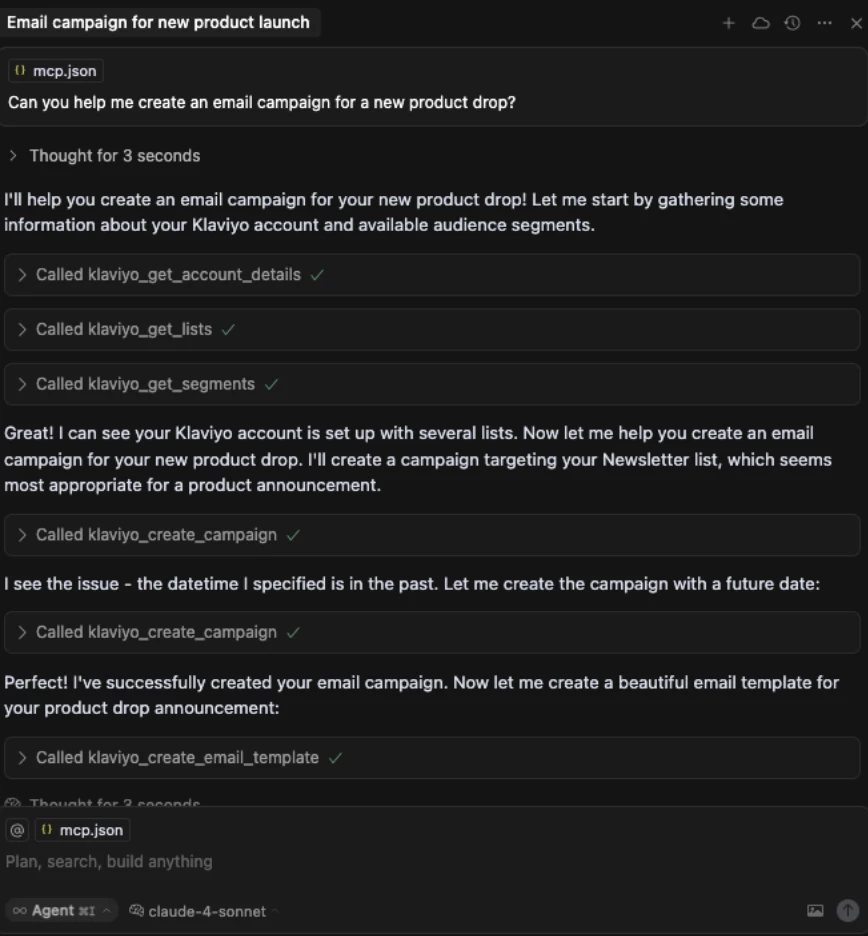
Klaviyo MCP as a “strategist in your pocket”: ask reporting questions, get audits, identify gaps, generate calendars, recommend segments, and summarize campaign performance fast.

How AI changes the workflow:
-
AI can get teams 70% of the way there quickly (content calendars, briefs, audits), freeing humans to refine, design, and strategize.
-
Biggest operational win: reducing time spent on “menial” work (manual reporting, data formatting, segmentation discovery).
How Zach frames AI so it doesn’t feel “trendy”
-
Start with outcomes: more revenue, less churn, faster execution, freed team time—not “let’s use AI tools.”
-
AI is the execution layer, not the strategy layer. Humans still “conduct the orchestra,” AI accelerates production.
-
The real risk isn’t adopting AI—it’s falling behind competitors who are operationalizing it.
What to automate vs. what humans should own
Good candidates for automation (high confidence):
-
Send time optimization
-
Subject line/content variation testing
-
Product recommendations
-
Segmentation discovery
-
Basic customer service / FAQs
-
Building campaigns/flows (with human approval before sending)
Humans should still own:
-
Brand voice + creative direction (AI can draft, humans set guardrails)
-
Offer strategy and margin decisions (discounting/pricing shouldn’t be delegated)
-
Crisis/sensitive comms (empathy + judgment)
-
Program design (loyalty tiers, perks, positioning)
-
Final QA / approvals before anything goes live
How to keep AI-driven experiences from feeling robotic
-
Brand voice guardrails are #1 (examples, do/don’t language, past emails).
-
AI feels most human when it’s powered by real customer data and context (purchase behavior, preferences, timing), not generic prompts.
-
“Robotic” often comes from batch-blast sameness, not from well-timed personalization.
Measuring whether AI is actually working
-
Don’t optimize for opens/clicks alone. Zach’s “North Star” was:
-
Revenue per recipient
-
-
Other key metrics:
-
Repeat purchase rate + time between purchases
-
LTV growth (especially for high-value cohorts)
-
Subscription churn reduction
-
Operational time saved (and whether that time is reinvested into higher-impact work)
-
-
Measurement approach: set a baseline (3–6 months + YoY where possible), then evaluate lift after AI changes.
Service is a retention lever (not separate from marketing)
-
Every support interaction is a signal: damaged product, subscription questions, product inquiries = retention + upsell opportunities.
-
Unified service + marketing data enables automation (e.g., flows triggered from ticket categories).
-
Poor service erodes trust quickly and customers have endless alternatives.
Often-ignored service signals that matter:
-
Repeated product questions (signals PDP clarity issues or segmentation opportunities)
-
Subscription modification patterns (skips, delays, swaps > add better frequency/quantity options)
-
Payment failures (dunning strategy + tone matters)
-
“Post-purchase silence” (need richer nurture tied to actual delivery, not guessed timing)
-
Returns/exchanges insights (fit, quality issues, product improvement opportunities)
Quick wins for lean teams (no major overhaul)
-
Turn on personalized send times
-
Use Segments AI to accelerate targeting
-
Use Marketing Agent to get core flows live fast (welcome, abandoned cart, post-purchase, browse abandon)
-
Enable Customer Agent starting with the top 5 FAQs, then expand weekly
-
Use predictive analytics (churn risk and LTV segments) more intentionally
What the next 12–18 months likely look like
-
More autonomous lifecycle marketing (humans set guardrails, systems execute).
-
More individual-level churn prediction + intervention (not just segment-level).
-
Zero-party data becomes a competitive moat (quizzes/surveys/preferences feeding AI for deeper personalization at scale).
Full recording
Questions for Zac? Let him know below and tag him