


Email, SMS, WhatsApp, or RCS: where does a message belong?
My framework for building a smarter messaging calendar across email, SMS, RCS, and WhatsApp
TL;DR
- Email carries anything that needs depth or story for us, and the real job there is segmentation and content, not more sending.
- SMS is for speed, like abandoned cart or welcome flows, and for hard promotional pushes, not day-to-day chatter.
- RCS only beats plain SMS when you're actually using the branding and the buttons, not just because the format exists.
- WhatsApp depends entirely on what's allowed in your market.
- The real skill isn't adding channels. It's deciding, on purpose, when to go quiet on one.
In DTC, retention lives on a thin line: you need the revenue now, but you also need the customer to come back, and every email, SMS, or WhatsApp message you send either builds that relationship or burns a little of it down. Adding channels doesn't fix this on its own, because being on email, SMS, and WhatsApp just means you have three places to send the same promo instead of one. A connected experience is different. Each channel has a specific job, and the customer never gets the same thing twice in a row from two directions at once. We need to be everywhere, but everywhere doesn't mean every time, and it doesn't mean every message.
Here's how I actually think through those decisions for Particle for Men, where every channel has to earn its place, and where I've learned to keep one quiet on purpose.
Start with the customer's behavior, not the channel
Before I pick a channel, I look backward at how the customer actually got here, because the moment I'm trying to reach sits at the end of a long acquisition funnel: a social ad or a TV spot, then a landing page, a product page, add to cart, checkout, payment, and every one of those steps leaves a trace of how that person really engages. Did he see the ad on his phone and wait until he was at his desktop to buy, or was it an impulse buy on mobile, in the moment? Either answer tells me where he's most active, and that behavior is a far better signal than guessing ever will be.
What job should each channel do?
Once I know how someone engages, here's the job I give each channel we actually use, and if you don't use one of these, skip it entirely. That's useful information in itself.
Email does the heavy lifting for us, mostly because it's the cheapest channel per send by a wide margin, and just about anything works there: promos, content, launches, transactional messages, all of it. Some performs better with a supporting message on another channel behind it, but email is still the one carrying the weight. What I'd rarely put anywhere else is anything that needs real depth or imagery: ingredient education, a routine walkthrough, before-and-afters, a full product story. None of that survives getting squeezed into a text. And the real job in email isn't sending at all, it's segmentation and content, because blasting everyone the same thing is exactly how you kill the channel.

SMS and RCS
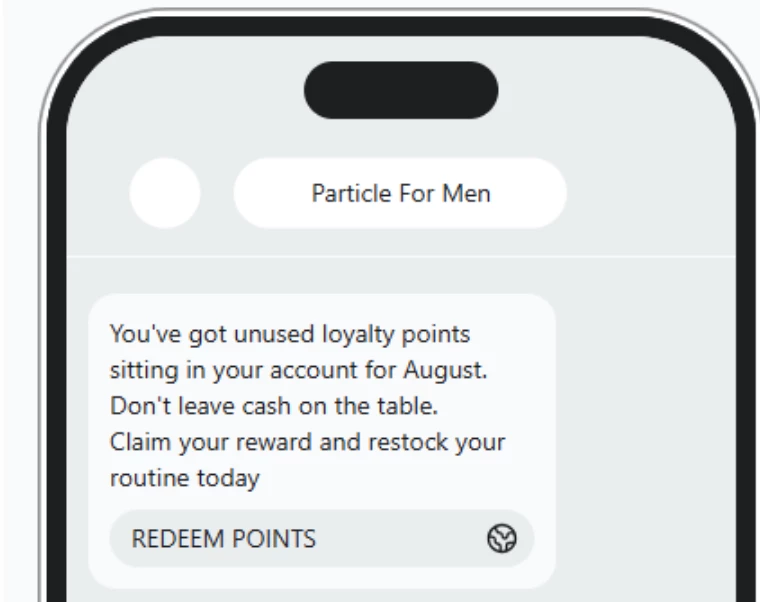
I use SMS for two things: fast resolution moments, like an abandoned cart or a welcome flow, where speed is the whole point, and hard promotional pushes like a sale or a product launch, where a short message that hits the target beats a long one nobody bothers to open. At Particle, we also stumbled onto something less obvious: loyalty messaging works unusually well on text, because it behaves like a transactional message, a points balance, a reward unlocked, something concrete about the account, but with a promotional angle tucked inside it. That combination is what actually gets read.
RCS does earn its place over plain SMS for us, though the reason is more practical than dramatic. What actually moves the needle is adding our branded logo to the message and swapping a plain link for a real button, not some inherent richness in the format itself. If RCS feels identical to SMS in your account, check whether you're using the branding and the button, because that's the difference we've seen.
We're not using WhatsApp right now, and it's less a strategic choice than a practical one: we can't run promotional messaging on WhatsApp in the US, and the US is our main audience. Klaviyo does support WhatsApp as a conversational channel, so this section might look completely different for you depending on where your customers are and what's currently allowed there. Don't rule it out on our account's behalf. Check the current rules for your own market before deciding. If you are interested in knowing more about how to use WhatsApp, check out this piece in the Community.
What does one customer journey look like, channel by channel?
Knowing the job each channel does is one thing. Watching how those jobs actually play out across a real customer, stage by stage, is where a framework either holds up or falls apart. Here's what that looks like end to end, mapped across a fairly standard journey: subscribe, browse, abandon cart, purchase, delivery, reorder, lapse.
| Stage | What I send | Channel | Why |
|---|---|---|---|
| Subscribe | The discount code they signed up for | Email and SMS, at the same time | They gave us both channels to get a code, so we use both, and there's no reason to stagger it while the iron's hot. |
| Browse | A soft reminder of what they looked at | Email first, SMS only if engagement is low | Intent is medium here, and an instant text right after someone browses can read as surveillance rather than service, especially for a skincare brand. Email is the safer opener. |
| Abandon cart | Depends on the offer | Email first if it's a plain reminder, SMS immediately if there's an incentive attached | A plain reminder can wait for email, but once there's an offer on the table, timing decides whether it works, and SMS becomes close to mandatory. |
| Purchase | A thank-you, what's next, and an ask for SMS consent if we don't have it | Email (SMS only for a bounce-back offer) | Email builds the excitement about what's coming, while texting someone who just paid rarely earns its cost since they're not buying again in the next hour. It is, though, the best moment to capture SMS consent, because new customers don't want to miss an order update. |
| Delivery | Shipping and delivery updates | Email (SMS optional) | Real-time delivery texts are great service and great branding, but they almost never generate revenue, so for us it comes down to a cost call, and transactional emails already engage well and protect the account's overall deliverability.* At Particle, email-only has been good enough here. |
| Reorder | A replenishment offer | Email, plus SMS for people whose channel affinity points to SMS | The hard part of replenishment is timing, and email is cheaper and faster to test with than SMS, so once that window works, we layer text onto the people who actually engage there. |
| Lapse | A win-back, usually with an incentive | SMS leading, email supporting | Email engagement is already damaged by the time someone lapses, that's part of what lapsed actually means, so SMS is what cuts through, especially with an offer attached. Timing varies by brand, some wait months, others move at 60 days, so use your own repurchase numbers to decide rather than borrowing someone else's timeline. |
Even more important than what I send is where I deliberately keep a channel quiet, and for us, that's right after a purchase and during delivery. Post-purchase, the customer just paid, and a text isn't going to make them buy again in the next hour, so all it really does is spend money and burn goodwill at the exact moment they're most positive about us. Delivery is the harder call, because real-time shipping texts are genuinely good service that customers actually like. We still went email-only there, though, because those messages almost never generate revenue, and the transactional emails were already carrying the engagement on their own.
How do you keep omnichannel from turning into over-messaging?
None of this works, though, if the channels start stepping on each other. Adding channels creates more chances to over-message, not fewer, and three things in particular keep that in check for us.
Timing
We almost never send email and SMS at the same time, except for something huge like BFCM. Klaviyo's own BFCM 2025 data backs up the exception: shoppers who got both email and text were meaningfully more engaged than single-channel shoppers, so the overlap earns its place there. Otherwise, email goes out in the morning and SMS goes out in the afternoon, mostly because email has a longer engagement window and gives it all day to work, while a text at 8 a.m. is just annoying, and people have less time to act on it than they would later in the day. That's our audience, though, so check your own engagement curve before you copy our hours.

Frequency
We send far more email than SMS, and that's entirely deliberate, because an email simply doesn't feel like an intrusion the way a text does. SMS is reserved for things that are genuinely important rather than day-to-day conversation, and the moment you start treating it as a daily channel is the moment you've lost it.
After someone converts
Recent purchasers are excluded from campaigns and from most flows, which is why we built rolling last 2-, 4-, and 8-week purchase segments and exclude those people from campaigns on both channels unless the message is actually relevant to them.
The thing people forget is that a customer sitting in a long post-purchase flow is already being messaged, because you chose that cadence in advance. Drop them into the campaign calendar too, and you're double-sending, and you did it entirely to yourself.
The rules I use for deciding where a message belongs
Everything above is specific to Particle, but the logic underneath it travels. If I had to boil it down to a few rules anyone could use, here's what I'd say:
- Let behavior pick the channel. If your audience responds better to SMS, run SMS-first, and skip the best-practice posts, because your own numbers tell the real story, and they'll tell you something different from the brand next door.
- Judge the channel on ROI, not engagement. Cost-effectiveness is the whole game here, not clicks and opens alone, because nobody is paying your salary for a great click rate.
- Collect SMS consent, then spend it carefully. It's easy to capture an email and harder to earn a phone number, for good reason, because a text is more personal than an email, and done badly, it costs you the relationship rather than just the click.
- A flow is a book, not a loop. Nobody wants to read the same chapter six times, so whether or not someone reacted to email 3, message 4 should continue that conversation instead of restarting it, trying a different angle or addressing a different barrier so they feel like you're actually listening, without ever making them say so themselves.
That's the system, and it's not universal, it's not supposed to be. The point is that every send has a reason, and every silence does too.
Be everywhere, just not every time.
Share your thoughts
Where in your journey have you deliberately turned a channel off, and what happened to revenue when you did?