
Segment for BFCM using customer signals, not default windows
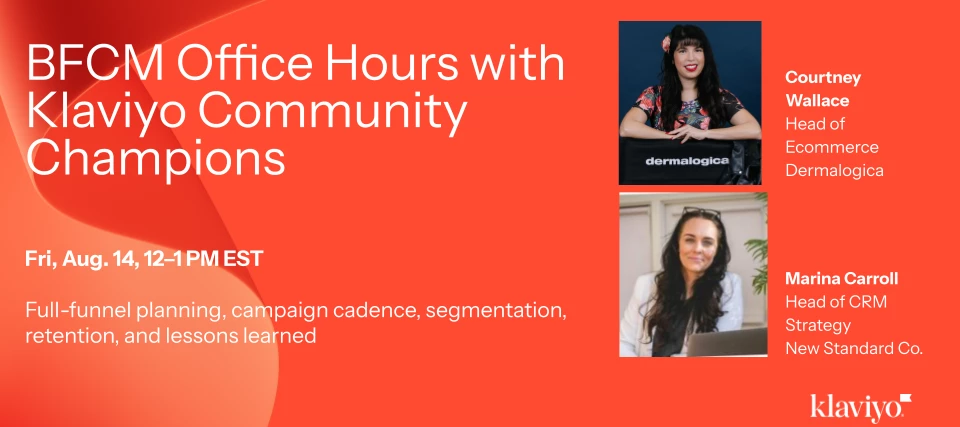
BFCM planning can easily become a race to add more campaigns, more segments, and more messages to the calendar. The strongest advice from our latest Office Hours with Klaviyo Community Champions was focused on: using customer signals to decide who gets what, when they get it, and what will help create the next purchase.
Courtney Wallace, Head of Ecommerce at Dermalogica, and Marina Carroll, Head of CRM Strategy at New Standard Co., shared practical lessons from working across different business models, product categories, and customer journeys.
How should you choose a BFCM segment – behavior or a default window?
A 30-, 60-, or 90-day engaged segment can be a useful starting point, but it should not become a permanent rule. The right audience depends on the product, the purchase cycle, and the behavior you want to influence.
For a premium brand with a long repurchase cycle, Courtney recommended starting with questions such as:
- How long does it typically take a customer to make another purchase?
- What product or collection signals show interest?
- Which customers need education or inspiration before they are ready to buy again?
- Which customers are already showing signs that they are ready for the next purchase?
The goal is to build an experience that feels relevant to the customer's journey. Not to place everyone into the same engagement bucket for every campaign.
Use campaigns as a testing ground, then automate what works
When Marina's team wants to improve second-purchase behavior, they often start with a campaign or cohort to test a theory. That might mean comparing a cross-sell recommendation with different offer types, or looking at what customers most often purchase after a specific product.
Once the team sees a pattern, it can be translated into a post-purchase flow. This creates a useful division of labor:
- Campaigns help you learn.
- Flows help you operationalize the learning.
One example Marina shared was using purchase data to identify the product customers most frequently bought next, then building that recommendation into the post-purchase journey. The same approach can help brands move beyond generic "shop again" messaging and give customers a more relevant next step.
Retention is about value, not just volume or discounts
For brands managing a busy campaign and transactional calendar, the answer to churn is not always another email. Before increasing volume, look at onboarding, suppression, channel choice, cancellation reasons, and the moments when customers begin to disengage.
Courtney shared how Dermalogica uses storytelling and gifts with purchase rather than percentage-off promotions. The message focuses on what customers gain: progress, convenience, education, product benefits, or the experience they may miss if they stop.
Marina added that bundles, loyalty benefits, free gifts, and other forms of added value can create urgency without training customers to wait for a discount.
The practical question is not simply, "What offer can we send?" It is, "What value does this customer need to understand right now?"
During BFCM, be broader, but still intentional
BFCM can justify a broader audience than a normal week. Longer-lapsed purchasers may be worth re-engaging when the offer or story is genuinely compelling, and some brands may choose to revisit profiles that were previously suppressed.
But broader does not mean indiscriminate. Marina emphasized the importance of using customer data to understand the longer journey. If a customer typically takes 48 days to purchase again, there may be no reason to message them every day until that window arrives. Recent purchasers may need space, while higher-value or high-intent audiences may warrant a different cadence.
The BFCM mindset is not "email everyone all the time." It is "be bolder when the moment is meaningful, and more thoughtful about the rest of the journey."
Personalization at scale needs a stopping point
Large catalogs create a familiar challenge: the more products a brand has, the easier it is to build a system that is technically personalized but operationally impossible to manage.
For brands with thousands of SKUs, Courtney and Marina recommended starting with collections or meaningful category-level cohorts. Use browsing, clicks, purchases, and other engagement signals to identify interest, then prioritize the categories and customer groups that drive the most revenue.
A useful rule of thumb: do not build a separate experience for every product just because you can. Start with the highest-impact groups, test whether the added relevance changes behavior, and only add complexity when the data supports it.
Which five flows should you prioritize before peak season?
If time is limited, focus on the flows that cover the most important moments in the customer journey:
Abandoned cart and welcome were highlighted as especially important places to test before the holiday rush. Post-purchase was described as an often-overlooked opportunity to guide customers toward a second purchase, build confidence in what they bought, and introduce a relevant next product or benefit.
For a deeper look at sequencing these flows without overlap, see this article by VP of Marketing at Happy Wax, Rachel Fagan 👇
Five actions to take before BFCM
- Identify two or three priority cohorts and define the behavior you want to influence for each.
- Audit your core flows for timing, filters, conditional logic, and overlap with campaigns.
- Test one value proposition that is not a straightforward percentage discount.
- Decide when email should be the default channel and when SMS should break through the noise.
- Use cancellation or churn feedback to shape the content customers receive when they begin to disengage.
The common thread across every discussion was prioritization. You do not need to build the most complex segmentation architecture or send the most messages to create a stronger BFCM program. Start with the customer signals you trust, test the ideas that matter most, and let the results determine where to add complexity.
Keep exploring
- BFCM Checklist 2026 — a phased guide to segmentation, flows, personalization, measurement, and post-BFCM retention.
- Advanced segmentation reference — examples for engagement tiers, holiday shoppers, churn risk, and cross-channel audiences.
- How to create a post-purchase flow — setup guidance for branching by customer and order signals.
- Fireside Chat Recap: Loop Earplugs' secrets to scaling during BFCM — a practitioner perspective on welcome flows, abandonment journeys, early access, and peak-season QA.
- How to segment with impact to increase ROI — community advice on behavioral segments, suppressing recent purchasers from sale reminders, and collecting preference data over time.
What’s one BFCM decision you’re still working through? Who to target, how often to send, or what to say after purchase?
Share the customer signal you’re using, what you’ve tested, or where you’re still stuck. Bonus points for sharing one segment or flow you’d recommend to another brand.