

Contributor I
Nov 18, 2026 12:30 PM UTC

Uniform random sample split

TLDR

You need to adjust the probabilities of a random sample split, if you have more than 2 paths and want a uniform distribution.


Personal story

Recently I created a 4-path split. My idea was simple - equally split the audience among the 4 paths, so 25% random sample on each path should be enough - at least that was what I thought.

If you click on the split element, you see that over each path a notification pops up: “Check first”, “Check second” and so on… That means that Klaviyo (correct me if I’m wrong) checks the first path and then the second one, and so on - path criterias are being checked in order and not independently of one another. What isn’t a problem for properties likes “Hasn’t placed an order in the last 5 days”, is actually a problem for random samples because of how probabilities work.


Probabilities

The probability of the second path being chosen with them both having 25% random sample, is 3/4*1/4=3/16 < 4/16=1/4. Imagine that 1/4 of your audience is on the first path (just like they should), then the remaining audience is 3/4. That means that the second path will be chosen for one quarter of 3/4 and not one quarter of 1 (100%) like it should be.


Solution (4 paths)

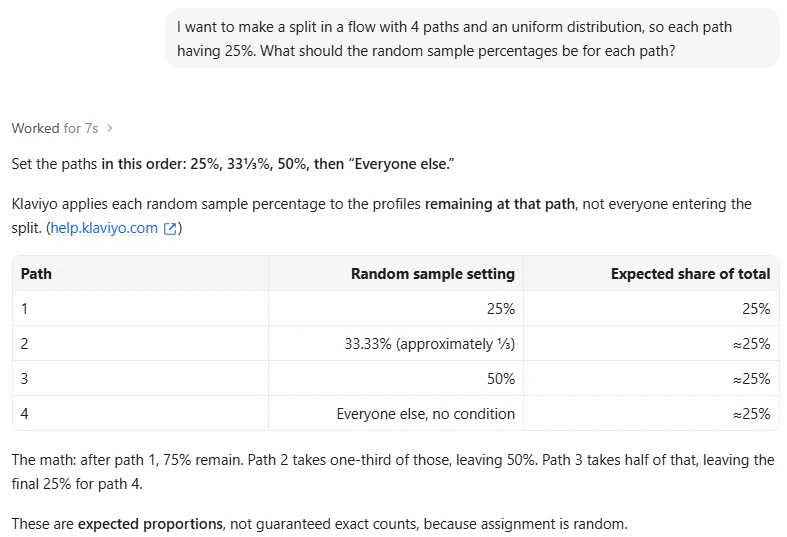
The solution for 4 paths is: 25%, 33%, 50%, 100% (being “everyone else”). This can be proven by calculating the probabilities for the second path: 3/4*1/3=3/12=1/4; the third path: 3/4*2/3*1/2=6/24=1/4; and the fourth path is just everyone else, so the remaining 25%.


It may sound complicated but it makes sense, once you play with the numbers on paper. Of course you can just ask Composer or any LLM to calculate the right probabilities.


Image:
 

Potential problems

The thing is that not everything that is intuitive, is also correct statistically. Problems will arise if you for example will compare the Conversion Rates for different paths and will see, that the first path is performing better than the rest. It does not mean that the first path is performing better, but rather that it has a larger customer group.

1 reply

Community Manager
Nov 18, 2026 3:35 PM UTC

Hi Artemii, 

Jumping in here to provide some confirmation from our resources! 

You are correct when stating that multi-branch splits will check each split path in order, not all at the same time. Even if you create a multi-branch split with 4 different paths, Klaviyo checks paths in order, not simultaneously, and sends each profile down the first path they qualify for. A profile can’t go down multiple paths from the same split.


The workaround that may suffice to show an approximately even 4-way random split, would be to set random samples on the first three paths to 25%, 33.3%, and 50% and then have the remaining profiles go to Everyone else. The percentages apply to the profiles remaining at each step, so the results are approximate—not guaranteed exact quotas.


If you use a random sample condition on a path, the percentage applies to the profiles evaluated for that specific path; not to all profiles entering the split. For example: 100 profiles enter a split. The first path uses a 50% random sample, so 50 profiles go down that path. The remaining 50 are evaluated for the next path, and a percentage condition there would apply to those 50.


Guide for reference: https://help.klaviyo.com/hc/en-us/articles/52369094030235


Your concern is not fully accurate, as a larger audience can produce more conversions, but it doesn’t automatically produce a higher conversion rate—the rate is conversions divided by the number of people in that path. If the paths are assigned randomly, different group sizes mainly affect how reliable the comparison is: smaller groups have more sampling noise. So a higher rate in the first path could be a real difference or random variation, but its larger size alone doesn’t explain the higher rate. More accurately: when comparing conversion rates across paths, account for sampling variability. Unequal group sizes affect the precision of each rate, not inherently its value.


Let me know if there is anything else we can look into on this for you!